Getting KPV to the colon
The particles and gels are among the most interesting parts of the experiment.
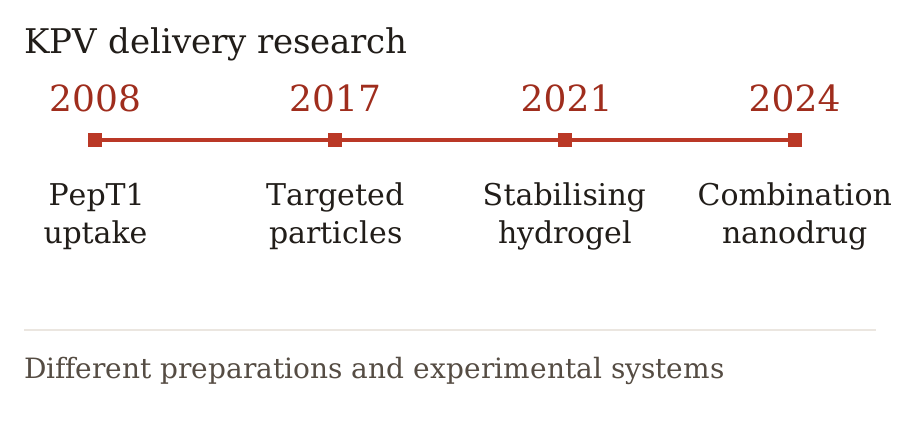
The delivery chronology
The PepT1 paper established a route of cellular uptake in its intestinal experiments. Later work added delivery materials: targeted nanoparticles inside a hydrogel, a hydrogel designed to stabilise KPV, and a co-assembled combination nanodrug. These are different experimental preparations.
I pay the carrier more attention after these formulation papers. These studies persuade me to divide the credit more carefully. A peptide, its carrier and a second active compound can each matter to the preparation under test. The chronology helps show why the question becomes more elaborate as the materials change.
Targeted particles in a gel
In the 2017 mouse-colitis study, KPV was carried in hyaluronic-acid-functionalised nanoparticles embedded in a chitosan/alginate hydrogel. The orally administered preparation reached inflamed colon tissue and showed a stronger capacity to prevent mucosal damage and reduce TNF-alpha than non-targeted delivery. Mucosal healing also accelerated relative to the non-targeted preparation.
That comparator is the valuable part for me. The study puts delivery design inside the question: changing the preparation changed the result in mice. It gives a reason to be interested in that particular construction, and a reason to ask exactly what another preparation contains before treating it as equivalent.
Stabilising KPV
The 2021 hydrogel paper studied a self-cross-linked material made from cysteamine-grafted gamma-polyglutamic acid. In the materials work, the system stabilised KPV and enabled controlled release. The chemistry is elaborate because the researchers were working on a practical delivery problem.
I like the stubborn physicality of this part of the literature. The peptide has to remain available in a useful form long enough for the experiment to work. A system that stabilises it is doing consequential work. This particular entry reports materials characterisation; it supplies a different kind of evidence from the mouse outcome in the earlier study.
The gel has a job of its own. “KPV” alone does not describe the complete preparation tested here.
A combination nanodrug
The 2024 study co-assembled KPV with an immunosuppressant into a PepT1-targeted nanodrug. In acute and chronic DSS-induced colitis in mice, the combination improved outcomes, restored tight-junction proteins and reduced inflammatory cytokines more than either agent alone. Tight junctions help neighbouring epithelial cells form a barrier.
The comparison gives my enthusiasm something concrete to rest on. The combination was tested against its individual agents, giving the result a clear experimental context. Crediting that entire improvement to KPV alone would discard the role of the other active compound and the preparation that brought them together.
The gut essay covers the earlier KPV experiments. Seen alongside them, these materials papers make delivery a subject worth pursuing in its own right.